

#
Lab 9 - Multiarea OSPF & GRE
Shrimp Co. is opening remote offices in Milwaukee and New Orleans. Implement multi-area OSPF for scalable routing and configure GRE tunnels to connect all locations over the internet.
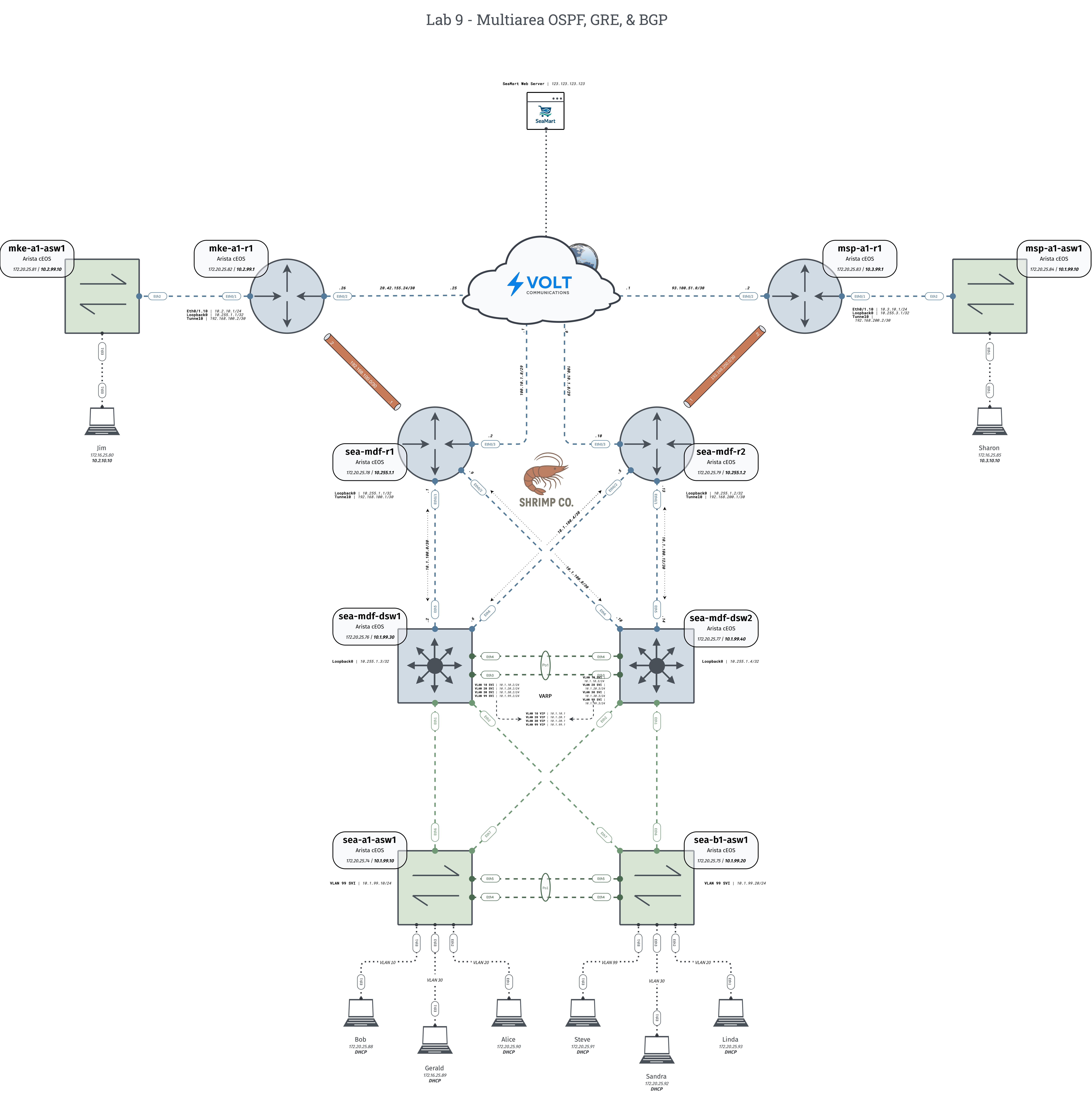
Tip: Individual topology files are available in the diagrams folder on my Github
#
Configuration Tasks
#
1. Access Layer Configuration:
Ensure access ports, trunks, VLAN databases, and port-channels are configured to span Layer 2 domain across all access and distribution switches.
- VLAN 10 – Sales
- VLAN 20 – Engineering
- VLAN 30 – Marketing
- VLAN 99 – IT
#
2. Distribution Layer Configuration:
- Routed Ports & Loopback0
- Configure routed ports and Loopback0 according to diagram
- VLANs, Trunks & Port-channels
- Ensure VLAN databases are matching and VLANs are allowed across all links
- VRRP Configuration
- Configure VIPs according to diagram
- Load balance active gateways using priority.
sea-mdf-dsw1should be active for VLANs 10 and 20,sea-mdf-dsw2should be the active gateway for VLANs 30 and 99. - Implement MD5 authentication
- OSPF
- Configure OSPF process 1 with passive-interface default
- Advertise all host subnets with a single summary network statement.
- Advertise Loopback0
- Form adjacencies on Eth5-6 in Area 0
- Utilize MD5 neighbor authentication
#
3. Router Configuration:
- Routed Ports & Loopback0
- Configure routed ports, Loopback0, and Tunnel0 according to diagram
- OSPF
- Configure OSPF process 1 with passive-interface default
- Form adjacencies on Eth0/1-2 in Area 0
- Form adjacency on Tunnel0 in Area 1 on
sea-mdf-r1(Requires remote site configuration) - Form adjacency on Tunnel0 in Area 2 on
sea-mdf-r1(Requires remote site configuration) - Originate the default route you receive from your BGP peer
- Advertise Loopback0
- BGP
- Configure BGP peering, refer to ISP provided documentation for details.
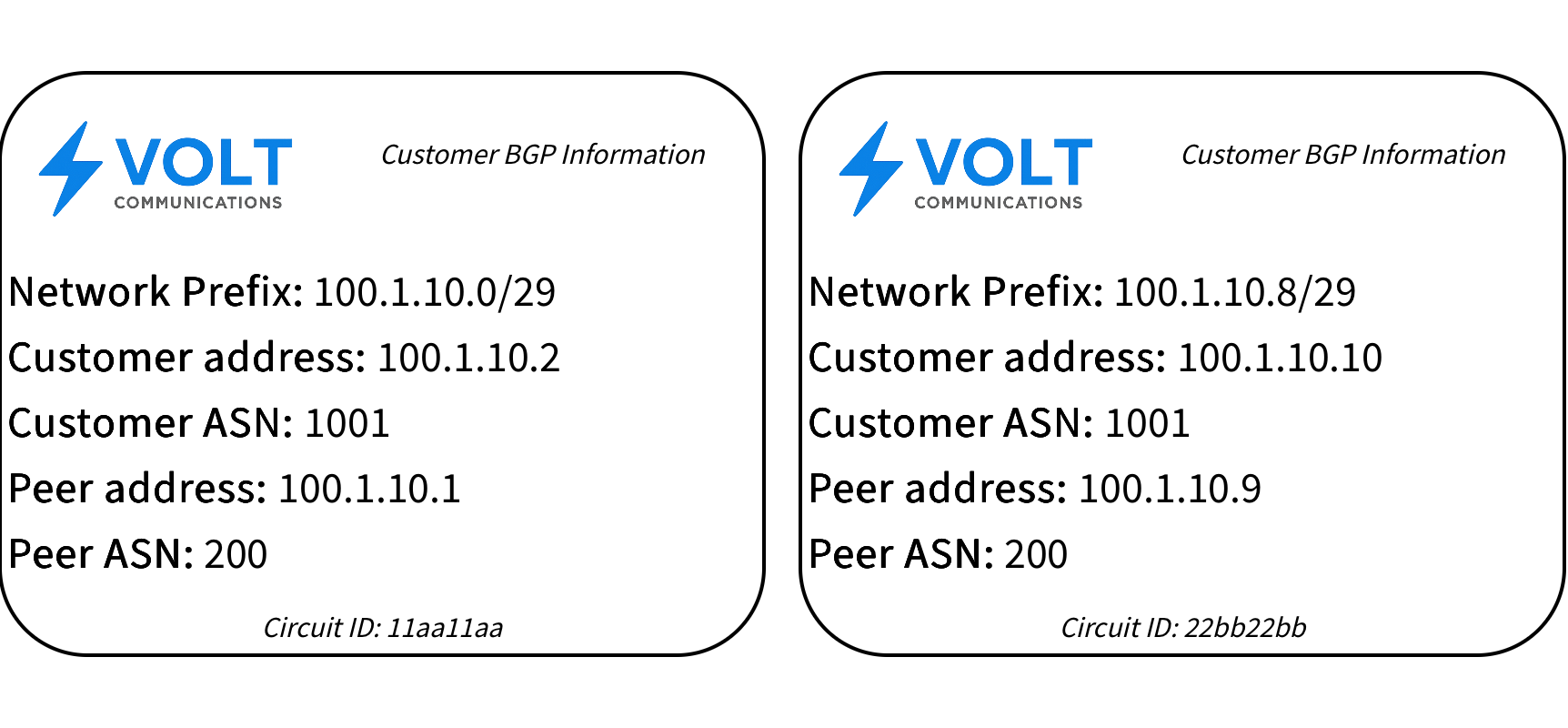
- Configure BGP peering, refer to ISP provided documentation for details.
- NAT
- Configure PAT on both routers, only matching host host subnet traffic.
- DHCP
- Configure DHCP Pools on both routers for all host subnets so that routers cannot provide overlapping IP addresses.
#
4. Remote Site Configuration:
- Switch
- Ensure VLAN 10 can reach it's gateway interface on the local router.
- Router
- Configure router subinterface and Loopback0 according to diagram
- Configure static default route to public next-hop
- Configure OSPF process 1 with passive-interface default
- Form adjacency on Tunnel0 in Area 1 on
sea-mdf-r1 - Form adjacency on Tunnel0 in Area 2 on
sea-mdf-r1 - Configure static NAT or PAT for local internet egress.
#
Success Criteria
- Hosts at HQ have ping reachability to remote sites
- Hosts at HQ can curl http://seamart.com
- Pings to the internet fail for Loopbacks but not hosts
- Encrypt WAN traffic on your GRE tunnels using IPsec tunnel protection
- Configure VARP instead of VRRP for your FHRP
- Have Jim & Sharon acquire a DHCP address across the WAN
- Configure EIGRP on your Tunnel interfaces, what additional configuration is needed for your remote sites to learn about networks at HQ and vise versa?
#
Verification Commands
show ip ospf neighbor
show ip route ospf
show interfaces tunnel0
show ip bgp summary
show ip bgp
#
Questions to Explore
- What happens to your switchports when MST is configured on one switch and Rapid-PVST is configured on the other?
- What's the smallest possible summary network statement you can use to advertise all host subnets? (No loopbacks)
- Traceroute to Jim from Bob. Why don't you see any public IP addresses in the output despite it crossing that infrastructure?
- Would Jim and Sharon still have internet reachability if you configured Areas 1 & 2 as totally stubby? What would be the fix while maintaining your totally stub areas??
Cisco Press - BGP Fundamentals IP Routing: OSPF Configuration Guide EOS OSPF Guide How to configure GRE Tunnel in CISCO Router How to configure GRE over IPSec in Cisco IOS and Cisco IOS-XE devices